

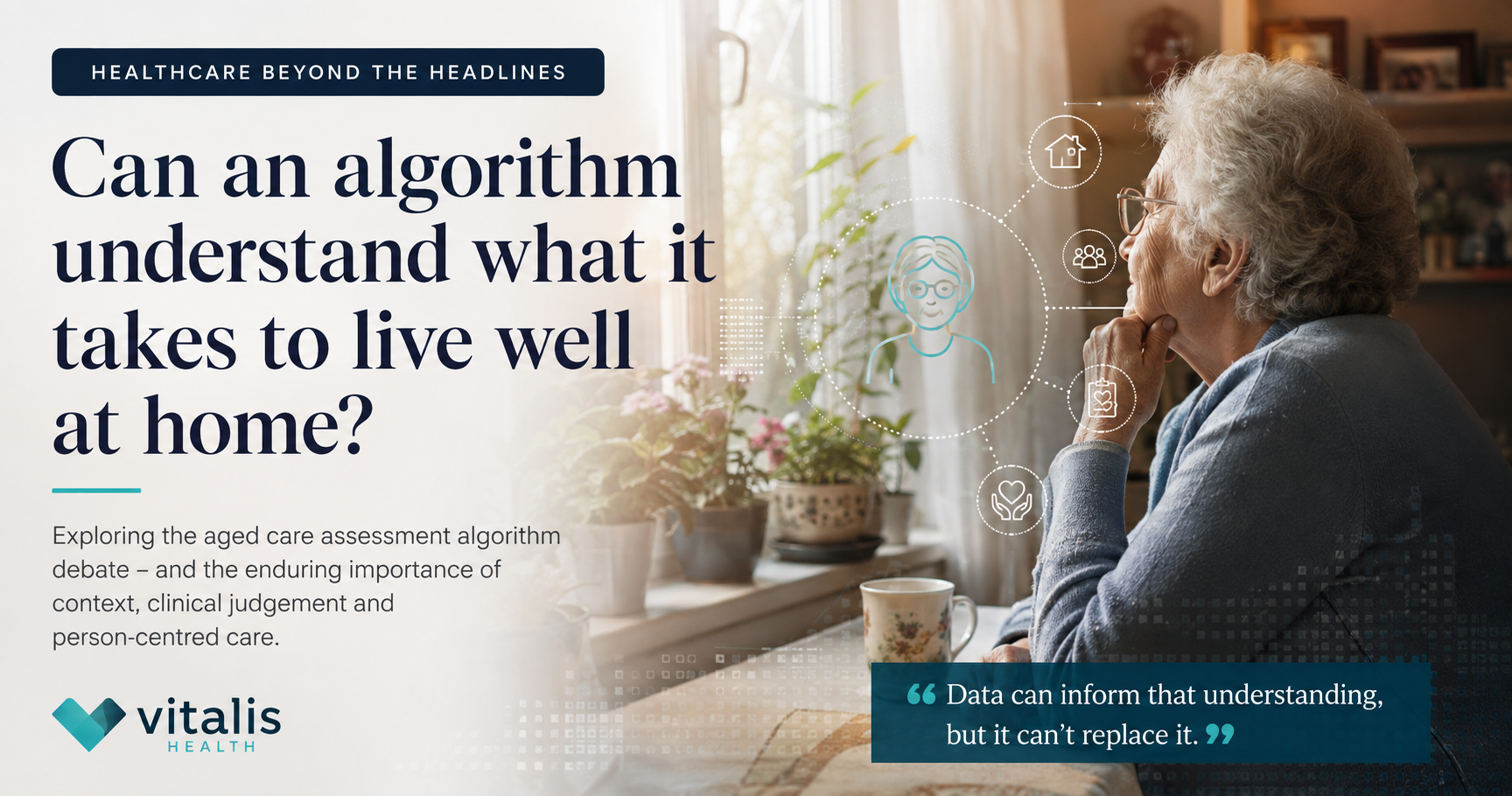
The controversy surrounding Australia’s aged care assessment algorithm raises a bigger question about data, human judgement and what person-centred care really means.
By the Vitalis Health Clinical Leadership Team
At 96, Audrey Staniland is blind, lives alone and relies on carers to help her remain in the Perth home she has lived in for more than four decades.
When her daughter sought a reassessment of Audrey’s government-funded home care late last year, hoping to restore care hours that had been lost as provider costs increased, a clinician visited Audrey at home. She observed how Audrey moved around the house, asked about her daily life and recorded information about her health, including her macular degeneration and emphysema.
But, as a recent ABC Four Corners investigation highlighted, the clinician did not ultimately determine Audrey’s funding classification. The information collected during the assessment was processed through the Integrated Assessment Tool (IAT), which includes a classification algorithm used to recommend the level of ongoing Support at Home funding. Audrey remained at the same funding level she had received for almost 12 years.
Her story has become part of a much broader debate about the role of algorithms in Australia’s aged care system.
It would be easy to reduce that debate to a familiar argument: computers versus humans.
But that misses the more interesting – and more important – question: Can data ever capture everything we need to understand about a person’s life?
Why use an algorithm in the first place?
Before considering the limitations of algorithmic assessment, it is worth understanding why Australia moved towards a more standardised system.
The IAT wasn’t created simply to automate aged care decisions. Introduced in 2024 as part of the Single Assessment System, it was designed to help assessors collect more comprehensive and consistent information and tailor recommendations to an older person’s needs. The Department of Health, Disability and Ageing describes the IAT as a dynamic assessment tool incorporating nested questions, clinical screening tools and more detailed exploration where concerns are identified.
There is a sound principle behind this.
Where access to publicly funded care is being determined, consistency matters. Two people with similar needs should not receive dramatically different outcomes simply because they live in different parts of Australia or happen to be assessed by different people.
Federal Minister for Health and Ageing, Mark Butler, made precisely this argument following the Four Corners investigation. He said the previous home care system had produced significant variation in package allocation across the country and defended the principle of a single assessment framework as a way of delivering greater equity, predictability and consistency. The Government says reviews of IAT outcomes represent less than half a per cent of the more than 200,000 assessments conducted under the new system, while also acknowledging the need for an additional escalation pathway in some cases. (Department of Health, Disability and Ageing)
So the question shouldn’t be: Is standardisation good or bad?
Standardisation can reduce inconsistency. Structured data can support better decision-making. Technology can help make complex systems more efficient and equitable.
The more difficult question is: Where should standardisation end and human judgement begin?
A person is more than the sum of their assessment answers
An aged care assessment necessarily turns aspects of a person’s life into information that can be recorded and compared.
Can they shower independently? How mobile are they? What medical conditions do they have? What assistance is available? What tasks can they perform around the home?
All of these questions matter.
But anyone who has spent time caring for people in their own homes also knows that need is rarely as straightforward as a series of individual answers.
Two people can be the same age, have the same diagnosis and appear to have similar functional capacity on paper, yet require very different levels of support to live safely and independently.
One may live with a partner who can provide support. The other may live alone.
One may confidently use a walking frame around a single-level home. The other may be frightened of falling in a house with steps and narrow corridors.
One may have family nearby. Another may have an adult child who lives interstate – or a family carer who is already stretched to their limit.
A person may technically be capable of preparing a meal, showering or taking medication. That doesn’t necessarily tell us how safely, reliably or confidently they can do those things every day.
Context changes need.
And much of that context only becomes apparent when we stop assessing a set of conditions and start understanding a person.
“Two people can have the same diagnosis, be the same age and appear very similar on paper, but they need very different levels of support at home. Good clinical care starts with understanding the whole person – their health, their home environment, the people around them and what matters to them. Data can inform that understanding, but it can’t replace it.” — Voni Leighton, Vitalis Health Founder and Clinical Director
Person-centred care requires context
This isn’t simply a philosophical preference for a more human approach to aged care.
It is embedded in Australia’s own definition of quality aged care.
The strengthened Aged Care Quality Standards require providers to understand each older person and tailor care to their individual needs, goals and preferences. The Aged Care Quality and Safety Commission’s guidance on person-centred care specifically recognises that, for care delivered at home, this can include understanding the person’s home environment, who lives with them, what family support they have and what other services they receive.
The new aged care legislation takes the same direction. Government guidance on the assessment process says assessors must consider an older person’s rights to independence, choice and control, discuss their preferences and goals, and involve family members, carers or advocates where the older person wants them involved.
That tells us something important about what aged care is trying to achieve.
We aren’t simply assessing impairment. We are trying to understand what someone needs to live well.
And those are not always the same thing.
The real issue isn’t algorithms versus people
The current controversy also risks creating a false choice.
Algorithms and structured assessment tools are not inherently incompatible with person-centred care. Used well, they can help clinicians process information consistently, identify issues that might otherwise be overlooked and reduce unwarranted variation in decision-making.
The IAT itself was developed with input from geriatricians, clinical assessors, peak bodies and older people, and the Government says it incorporates validated assessment tools intended to provide clinical depth and rigour. (Department of Health, Disability and Ageing)
The problem arises when we ask a tool to do something its inputs cannot fully support.
The Four Corners investigation reported that the IAT contains more than 500 questions and more than 100 text fields where assessors can record additional information. Yet its analysis raised questions about how much of that information actually contributes to the classification algorithm that determines the recommended funding level. (ABC Four Corners)
That distinction matters.
A system can collect an enormous amount of information about a person and still fail to give appropriate weight to the information that matters most.
This is why human judgement remains so important.
An experienced clinician doesn’t simply collect information. They interpret it. They recognise interactions between conditions, risks and circumstances. They notice what isn’t captured neatly by a checkbox. They ask another question when an answer doesn’t quite make sense.
Most importantly, they can recognise when the output in front of them doesn’t reflect the person sitting in front of them.
When should a human be able to say, “That doesn’t look right”?
That question is now at the centre of the political debate.
Criticism of the IAT has focused particularly on the ability of assessors to exercise professional judgement over the classification generated by the algorithm. The Senate has passed legislation seeking to restore a human override, although that change would also need to pass the House of Representatives to become law. The Government has instead indicated it will introduce an escalation pathway for cases where an outcome appears inappropriate. (The Guardian)
There are legitimate arguments to consider on both sides.
Allow unlimited discretion and the consistency a standardised system was created to achieve can begin to disappear. Remove too much discretion and there is a different risk: that consistency becomes rigidity.
Perhaps the better principle is not that human judgement should always override an algorithm.
Nor that an algorithm should always override human judgement.
It is that a system should have a meaningful way of recognising when the two disagree.
If an experienced assessor believes the outcome generated from an assessment does not reflect the needs of the person they have just spent time with, that disagreement is itself valuable information.
A well-designed system should be curious about it.
What this means beyond aged care
There is a bigger healthcare story here.
Algorithms, artificial intelligence and automated decision-support tools will increasingly influence the way healthcare is delivered. They will help identify deterioration, predict risk, prioritise resources and support clinicians to make sense of volumes of information that no individual could process alone.
That should be welcomed.
At Vitalis Health, we already use technology to extend the reach of clinicians and support care beyond hospital walls. Our Virtual Program, for example, combines remote patient monitoring with nurse-led telehealth and defined clinical escalation pathways. In our own program data, patient engagement remained above 80% across all phases of care while scheduled clinical follow-up remained at 100%. (Vitalis Health)
But our experience has reinforced an important distinction:
Data can tell us that something has changed. Clinical judgement helps us understand what that change means for this person.
A blood pressure reading has context. A missed symptom survey has context. A person’s ability to manage safely at home has context.
The opportunity presented by better technology isn’t to remove that context from healthcare. It is to give clinicians better information with which to understand it.
Looking beyond the headlines
The debate surrounding Australia’s aged care assessment algorithm will continue.
The tool may change. Its safeguards may change. The way human oversight operates may change.
But there is a principle here that should outlast the current controversy.
Data can describe a person.
It can tell us their age, diagnoses, mobility, functional capacity and hundreds of other things about them.
What it cannot always tell us is what it feels like to navigate their bathroom when they cannot see. Whether they feel safe alone at night. Whether the daughter who helps them is coping. Whether losing a few hours of support is merely inconvenient – or the difference between remaining independent and no longer managing at home.
Those things are harder to quantify.
They are also part of healthcare.
As we build more sophisticated systems to help allocate resources and make decisions, the challenge isn’t to choose between technology and people.
It is to design systems that take advantage of what each does best.
Because better data can help us understand more about a person.
But good care still begins with listening to them.
About Healthcare Beyond the Headlines
Healthcare Beyond the Headlines is a thought leadership series from Vitalis Health exploring the major news stories shaping Australian healthcare – and what they really mean for patients, families, clinicians and the future of care.
References
- ABC Four Corners – Inside the aged care algorithm deciding support for older Australians
- Australian Government Department of Health, Disability and Ageing – Assessment tools for the Single Assessment System
- Australian Government Department of Health, Disability and Ageing – Funding classifications for Support at Home
- Australian Government – Aged care needs assessment process
- Aged Care Quality and Safety Commission – Person-centred care
- Australian Government – Minister Butler press conference, 18 August 2026
- Vitalis Health – Patient engagement in the Vitalis Virtual Program