

What the recent Telstra outage reveals about designing healthcare for continuity
By the Vitalis Health Clinical Leadership Team
When the recent Telstra outage disrupted communications across Australia, the immediate focus was understandably on restoring the network.
How did it happen? How long would it last? How could it be prevented from happening again?
They were reasonable questions. But for healthcare providers, there was another question – one that may prove even more important in the years ahead.
What happens when the systems we rely on to deliver care suddenly become unavailable?
For most Australians, the outage was an inconvenience. For others, it was considerably more serious. During the disruption, families were unable to contact vulnerable loved ones, while some calls to Triple Zero failed to connect. Telstra later confirmed it had undertaken 639 welfare checks, with 170 cases referred to police for further follow-up and at least seven people requiring emergency assistance.
This wasn’t simply a telecommunications story. It was a reminder that, for many Australians, staying connected is now fundamental to health, safety and independence.
As healthcare increasingly moves beyond hospitals and into people’s homes, the Telstra outage raises an important question that extends far beyond telecommunications:
How do we design healthcare systems that continue supporting people when technology is disrupted?
Healthcare is becoming more connected than ever before
Healthcare is undergoing one of the most significant transformations in its history.
Remote patient monitoring, virtual consultations and connected medical devices are changing the way clinicians care for people living with chronic disease, recovering after hospitalisation or requiring ongoing clinical support at home. Rather than relying solely on episodic appointments, clinicians can now monitor health trends over time, identify early signs of deterioration and intervene before problems escalate.
This transformation is not simply about convenience. It reflects a broader shift towards delivering more healthcare where people increasingly want to receive it: in their own homes.
For patients, that can mean avoiding unnecessary travel, spending less time in hospital and maintaining greater independence. For health systems facing an ageing population, increasing demand and workforce pressures, it offers opportunities to improve access while making better use of finite clinical resources.
Recognising this shift, the Australian Commission on Safety and Quality in Health Care has begun developing Australia’s first dedicated Virtual Care Standards, acknowledging that virtual models of care are becoming an increasingly important part of the healthcare system and require robust clinical governance and quality frameworks.
Technology has made much of this transformation possible. But technology alone is not what makes these models successful.
Technology doesn’t replace clinical judgement
Digital health often attracts attention because of the technology itself. Artificial intelligence, remote monitoring platforms, wearable devices and connected sensors are all innovations that are transforming healthcare.
But they all perform essentially the same function: they generate information.
Information, however, is not the same as understanding.
A monitoring platform may detect a change in a patient’s vital signs, artificial intelligence may identify a concerning pattern and a connected device may generate an alert that something requires attention. But none of these technologies can determine whether the change is clinically significant, understand a patient’s broader circumstances or decide on the most appropriate course of action.
That responsibility must remain with clinicians.
Technology extends the reach of clinical teams – it enables them to see more, know more and respond sooner. Clinical judgement then determines what happens next.
The distinction matters because the future of healthcare is unlikely to be defined by replacing clinicians with technology. Rather, it will be defined by using technology to enable clinicians to deliver safer, more timely and more personalised care.
Technology supports care. Clinical judgement makes the difference.
Continuity doesn’t happen by accident
Perhaps the most valuable lesson from the Telstra outage has little to do with telecommunications, but it has everything to do with healthcare design.
When a communications network experiences disruption, attention naturally turns to restoring the service. Yet good healthcare should never depend upon a single point of success.
Whether the challenge is a telecommunications outage, an internet failure, an extreme weather event or simply an unexpected deterioration in a patient’s condition, people should continue receiving safe, coordinated care.
That requires more than reliable technology. It requires continuity by design.
A well-designed model of care doesn’t assume everything will always work perfectly. Instead, it deliberately builds continuity into the way care is delivered through:
- Regular clinician engagement, rather than passive monitoring
- Clear escalation pathways when a patient’s condition changes
- Strong clinical governance supporting decision-making
- Integration between virtual and in-person care, rather than treating them as separate services
- Continuity of relationships between patients, families and healthcare teams.
Technology is one part of that system; it is not the system itself.
This means the organisations best positioned for the future will not necessarily be those with the newest technology. They will be those that thoughtfully design technology around expert clinical insight and execution.
Designing healthcare around people
Australia’s healthcare system is changing rapidly. The population is ageing, chronic disease is becoming more prevalent and demand for healthcare continues to increase, while workforce shortages remain a significant challenge across many parts of the system.
Technology will undoubtedly play an increasingly important role in addressing these pressures.
The more interesting question is not whether healthcare should embrace technology.
It is how technology should be used.
Too often, conversations about digital health begin with capability:
- What can artificial intelligence do?
- How much data can remote monitoring collect?
- How sophisticated is the platform?
These are important questions, but they are not the most important ones.
We believe healthcare providers should instead ask:
- Does this technology strengthen continuity of care?
- Does it enable earlier intervention?
- Does it improve coordination between clinicians?
- Does it help patients remain safely at home?
- Does it strengthen relationships between patients, families and healthcare teams?
If the answer is yes, then technology is creating genuine healthcare value. If not, it risks becoming innovation without meaningful clinical impact.
The Vitalis perspective
At Vitalis Health, this philosophy shapes the way we design care.
Our Virtual Program integrates remote patient monitoring, regular clinician engagement, telehealth consultations and in-person clinical care into a single connected model that adapts as a patient’s needs change.
Technology provides visibility, clinical expertise provides context – and together they enable earlier intervention, stronger continuity of care and more personalised support delivered where many people most want to receive it: at home.
Importantly, technology is never viewed as a replacement for clinicians. It is a tool that helps clinicians deliver better care.
That distinction sits at the heart of connected healthcare.
Looking beyond the headlines
The recent Telstra outage will eventually fade from public memory. The questions it raised should not.
Healthcare is becoming increasingly connected, and that is unquestionably a positive development. Virtual care, remote monitoring and digital technologies have enormous potential to improve access, strengthen continuity and support more people to receive high-quality care in their own homes.
But technology is only one part of the equation.
The future of healthcare will not be defined by the sophistication of the platforms we adopt. It will be defined by how thoughtfully we design care around the people who depend on it. Because when technology inevitably encounters challenges – as every system eventually will – the measure of a healthcare model is not whether the technology failed.
It is whether the care continued.
About Healthcare beyond the headlines
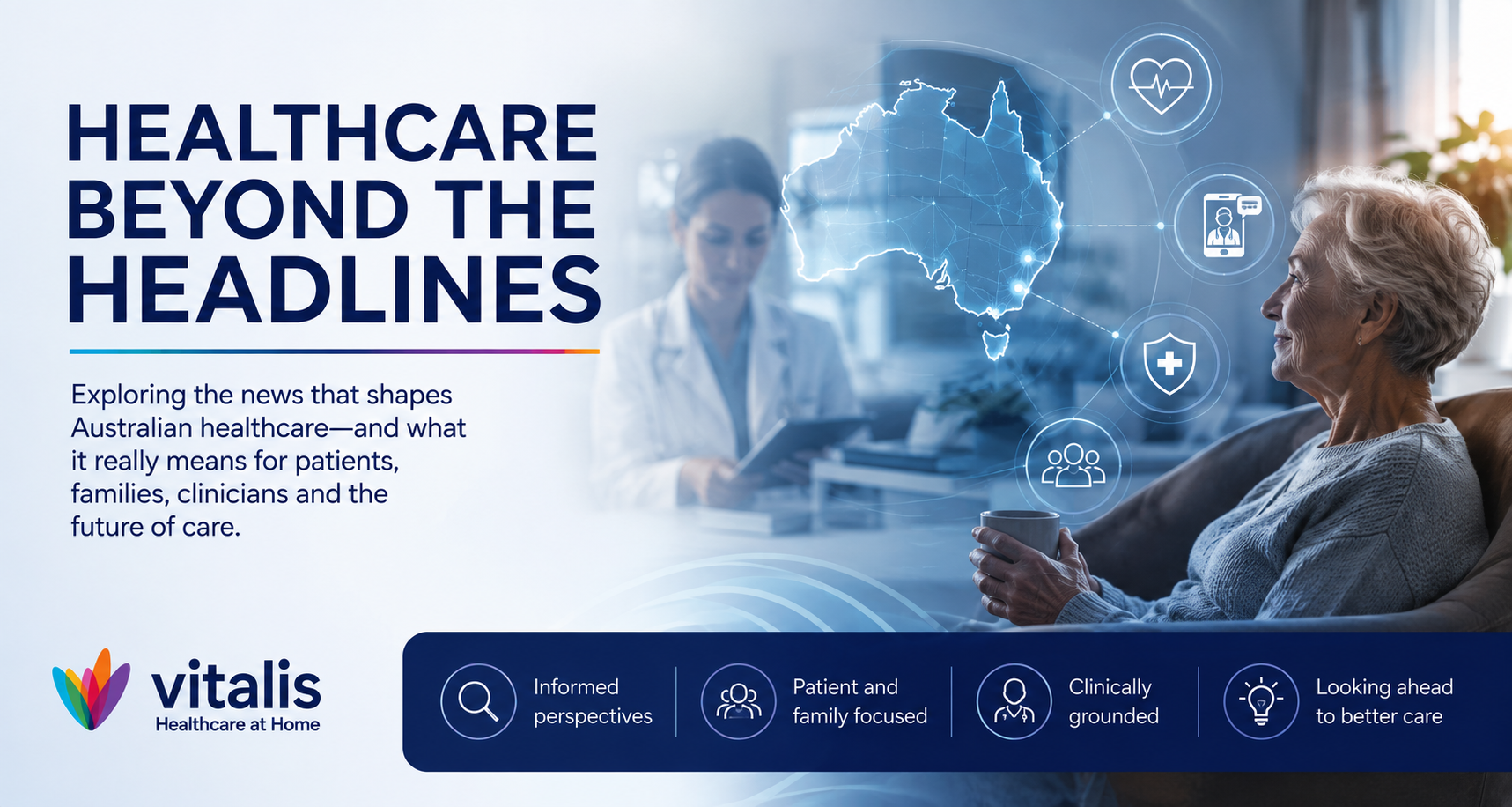
Healthcare beyond the headlines is a thought leadership series from Vitalis Health exploring the major news stories shaping Australian healthcare – and what they really mean for patients, families, clinicians, providers and the future of care.
References
- ABC News – Telstra outage: ‘Software defect solution’ in place after hundreds unable to call Triple Zero
- ABC News – Timeline shows delay before Telstra alerted minister to network outage
- Australian Commission on Safety and Quality in Health Care – Strengthening virtual care quality
- Australian Government – Statement: Telstra Outage
- Australian Government – Statement: Update on Telstra outage