

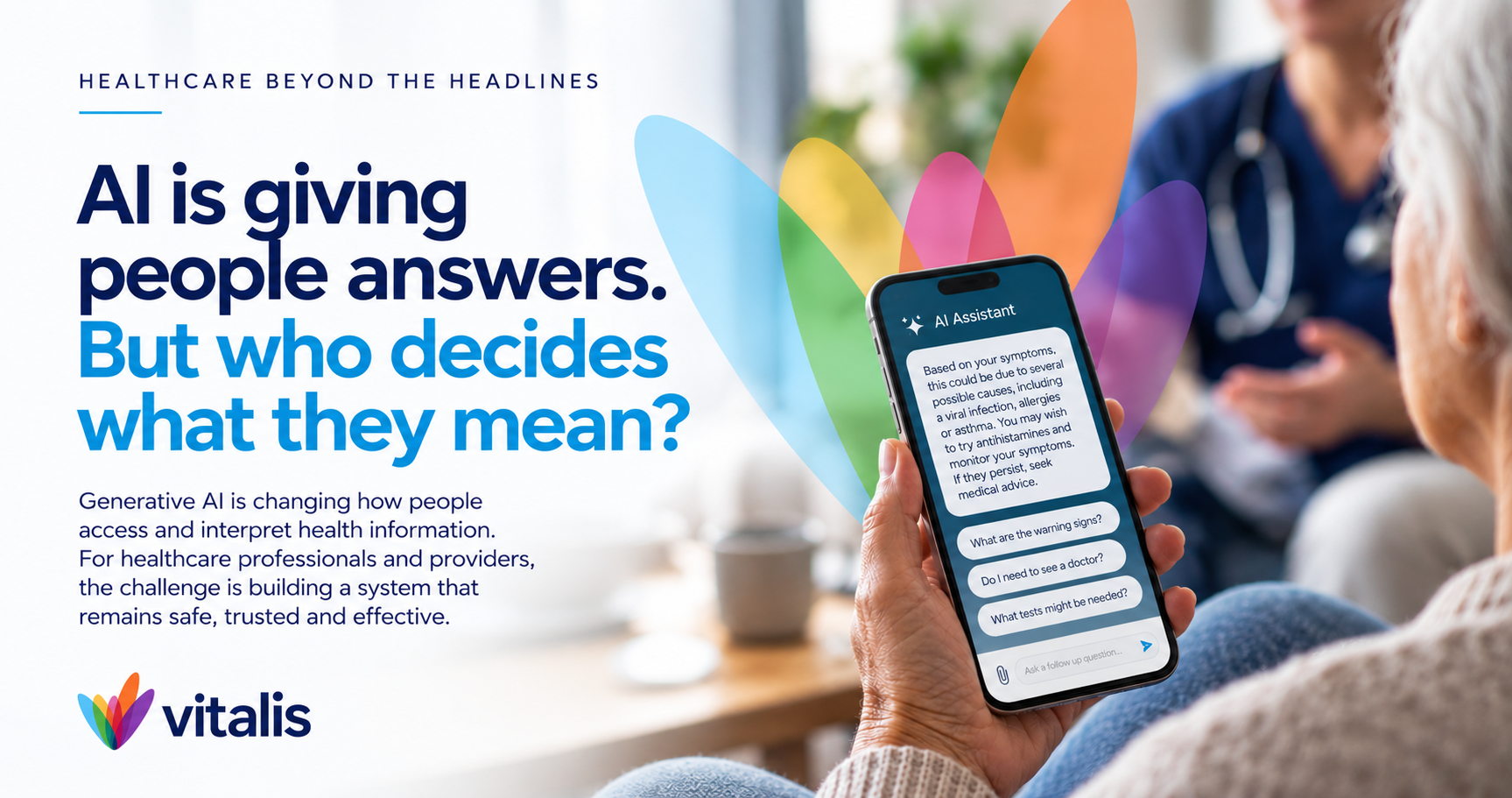
As AI becomes increasingly capable of interpreting health information, the challenge for healthcare professionals and providers is not whether technology can generate an answer – but how it can support safe, clinically led decisions?
By the Vitalis Health Clinical Leadership Team
For generations, the relationship between patients, clinicians and medical information was relatively straightforward. When something did not feel right, people might ask a family member, speak to a pharmacist or make an appointment with their GP. Medical knowledge largely sat within the healthcare system, and clinicians acted not only as providers of care, but as interpreters of that knowledge.
Then came Google – and, not long afterwards, “Dr Google”.
Search engines fundamentally changed that relationship. Medical information that had once been difficult for the public to access suddenly became available to anyone with an internet connection. Patients increasingly arrived at consultations having researched their symptoms, possible diagnoses and treatment options – sometimes better informed, sometimes unnecessarily alarmed, and often carrying a mixture of reliable clinical information, personal experience and material of considerably more questionable provenance.
For healthcare professionals and providers, this required an adjustment. The consultation was no longer necessarily the beginning of the patient’s search for answers. Increasingly, it became the place where information gathered elsewhere had to be interpreted, contextualised and, where necessary, corrected. For healthcare providers, the change was broader still: patient education, digital engagement and clinical pathways increasingly had to account for people arriving with information – and expectations – formed outside the healthcare system.
Generative artificial intelligence represents another significant shift. Google largely gave patients information to navigate. AI can synthesise information and provide something that feels much closer to an answer – detailed, conversational, personalised and often remarkably authoritative in tone.
The distinction matters because AI is moving beyond simply helping people find health information. The Australian Government already identifies clinical decision support, analysis of medical records, imaging and monitoring among the ways AI is being used in healthcare.
Australia’s regulators have also drawn an important line around how that technology should be used. Ahpra’s guidance on artificial intelligence in healthcare states that practitioners remain responsible for delivering safe and quality care regardless of the technology involved, and that they “must apply human judgment to any output of AI”.
That principle deserves more attention than the familiar debate about whether AI will eventually replace doctors. The defining question for AI in healthcare is not simply whether the technology can produce an answer, but who – or what – determines what that answer means for an individual patient.
From searching for information to receiving an answer
There is plenty to welcome in this change. Complicated medical terminology can be translated into everyday language. Patients can learn more about a diagnosis, better understand the purpose of a test or medication, and arrive at appointments equipped to ask more informed questions.
AI can also do something qualitatively different from the search engines that preceded it. Rather than requiring someone to navigate multiple sources and reconcile conflicting information themselves, generative AI can interpret a question, synthesise information and present a coherent response.
That accessibility has obvious potential to improve health literacy and patient engagement. But it also creates a new challenge for healthcare professionals and providers: a coherent answer is not necessarily a clinical assessment.
Healthcare rarely begins with a complete set of facts. Patients do not generally present clinicians with every symptom, medication, risk factor, observation and piece of medical history required to make an assessment. They describe what they have noticed and what is concerning them. A skilled clinician then determines what else they need to know.
That might mean asking another question, reviewing pathology results or medications, taking someone’s blood pressure, listening to their chest or noticing that they appear unusually breathless, confused or unsteady. Sometimes the most clinically important information is something the patient did not realise was relevant enough to mention.
A general-purpose AI system can only interpret the information available to it. That creates an important distinction between generating a plausible explanation from the information provided and making a clinical assessment of an individual patient. But what happens when AI has access to considerably better information?
What happens when AI has better information?
This is where the conversation becomes more interesting.
Imagine an AI-enabled healthcare system is not relying solely on someone typing, “I’ve been feeling dizzy today.” Imagine it can also help make sense of recent blood pressure readings, heart rate, oxygen saturation, medications, pathology results, clinical history and changes from that person’s usual baseline.
That is a very different proposition from Dr Google. AI may be exceptionally good at detecting patterns across large volumes of information. It may identify a change that deserves attention earlier than a clinician reviewing individual data points could. It may help prioritise information, identify correlations and surface something clinically significant from an increasingly complex stream of health data.
The Australian Commission on Safety and Quality in Health Care recognises AI-supported decision-making, remote monitoring and virtual care as part of the emerging landscape of digitally enabled care. Its 2026 National Model for Clinical Governance makes clear that robust clinical governance is required whether care is delivered face-to-face or digitally, and that governance structures need to evolve as AI and other digital technologies become integrated into clinical workflows.
This is closely aligned with the direction we are exploring at Vitalis. The opportunity we see for AI is not to replace the clinician at the point of decision. It is to help clinicians make better sense of the information available before that decision is made.
Bringing together verified clinical information – observations, medical results, medication information, clinical history and changes over time – can create a much richer picture of what is happening to someone than any single data point can provide. AI may increasingly help identify patterns within that information, highlight changes and bring the right information to a clinician’s attention.
But the next question remains clinical: what should happen now?
The answer might be nothing. It might be another observation, a phone call, a telehealth consultation, an in-person clinical assessment, a change to the care plan or escalation to hospital. The value of the technology lies not in removing that judgement, but in giving the clinician a richer picture on which to base it.
Information is not the same as meaning
Consider something as simple as a blood pressure reading. An algorithm can identify whether the number sits outside an established range. A more sophisticated system might compare it with previous readings, identify a trend and consider other available observations.
But what does that change mean for this particular patient? Has their medication recently changed? Are they unwell? Are they dehydrated? Is the reading unusual for them? Are there other symptoms? Is it clinically significant enough to warrant intervention, or is monitoring appropriate?
The number is information. The pattern may be information. Even an AI-generated interpretation is information. Clinical judgement determines what should happen because of it.
This is why the Ahpra guidance is so important. It does not reject AI or treat human and artificial intelligence as competing alternatives. Instead, it places AI within the existing framework of professional accountability. Practitioners need to understand the tools they use, consider their limitations, be transparent where appropriate and remain accountable for the care delivered.
The Australian Commission’s clinical guidance takes a similar approach. It asks clinicians to understand the evidence supporting an AI tool, recognise its clinical risks and limitations, and remain accountable for AI outputs that inform clinical decisions or records.
Are we asking the wrong question?
Much of the public discussion about AI and healthcare still gravitates towards competition. Will AI replace doctors? Can an algorithm diagnose more accurately than a human? Should patients trust a chatbot?
Those questions make good headlines. But they also risk creating a false contest – and almost a false equivalence – between technology and clinical expertise.
Human clinical expertise is not optional. It has to remain the cornerstone of healthcare.
So the more useful question is: how can AI make clinically led healthcare better?
AI can process enormous quantities of information, identify patterns and surface changes that might otherwise be difficult to see. Remote monitoring can reveal what is happening to someone between clinical encounters. Digital platforms can extend healthcare beyond the traditional hospital or consulting room. As these technologies become more sophisticated, they may help healthcare professionals identify deterioration earlier, make better-informed decisions and direct clinical resources more effectively.
But their value ultimately depends on what happens next. A pattern still needs to be interpreted. An alert needs to be assessed. Information needs to be considered in the context of the individual patient. And when a decision affects someone’s care, appropriately qualified healthcare professionals must remain accountable for that decision.
This is why the distinction between AI replacing clinical judgement and AI augmenting clinical judgement matters so much. The latter has enormous potential.
For healthcare professionals, AI could help reduce the burden of finding the signal among an ever-growing volume of clinical information – providing a more complete and continuous picture of a patient’s health and bringing significant changes to attention earlier.
For healthcare providers, the challenge is broader. It is not simply about adopting AI, but designing models of care in which technology operates within appropriate clinical governance, with clear accountability and escalation pathways – and with clinical expertise embedded wherever decisions about patient care are made.
This is consistent with the direction being set by Australia’s regulators. Ahpra makes clear that practitioners remain responsible for safe and quality care and must apply human judgement to AI outputs.
Clinical expertise is not the counterweight to AI. It is the foundation that allows AI to be used safely and meaningfully in healthcare.
From information to action
That distinction becomes particularly important as more healthcare moves into the home.
A hospital provides clinicians with an environment designed around observation and intervention. When care moves beyond hospital walls, technology can help extend that clinical visibility. Remote observations, pathology results, health records and other sources of information can begin to provide a picture of what is happening to someone between physical clinical encounters.
The potential role for AI is considerable. It could help clinicians identify important changes earlier, make connections across different sources of information and direct attention towards the people who may need intervention.
But ultimately someone still has to determine what that information means. Does the patient need reassurance? Another set of observations? A clinician on the phone? Someone at their home? A change in their care plan? Or does their condition require escalation to hospital?
This is where information becomes care. The most exciting future for AI in healthcare may not be one in which technology makes clinicians less necessary. It may be one in which clinicians can make better-informed decisions, earlier, because technology gives them a clearer and more continuous picture of the person they are caring for.
Looking beyond the headlines
We are not going back to the world before Dr Google, and generative AI will almost certainly become a more significant part of how patients access health information and how healthcare professionals work with clinical data.
For healthcare professionals and providers, the challenge is to build something better around that reality. That means designing AI around evidence and safety, connecting digital information with professional care when appropriate, ensuring clinicians understand the technologies influencing their decisions, and keeping those technologies within robust clinical governance.
The Australian Commission defines digitally enabled care not simply as the use of technology, but as its appropriate integration and application to deliver, augment or coordinate patient care. That word – integration – may ultimately be more important than any individual technology.
AI will almost certainly become better at identifying patterns, synthesising clinical information and suggesting what those patterns might mean. The challenge is to harness that capability within models of care where clinical expertise, governance and accountability remain non-negotiable.
Ahpra’s position provides a useful starting point: technology may inform a clinical decision, but responsibility for safe, quality care remains with the practitioner.
Perhaps that is the distinction that matters most.
AI can provide the answer. Good healthcare still has to decide what it means – and what happens next.
About Healthcare Beyond the Headlines
Healthcare Beyond the Headlines is a thought leadership series from Vitalis Health exploring the major news stories shaping Australian healthcare – and what they really mean for patients, families, clinicians and the future of care.
References
- Australian Health Practitioner Regulation Agency (Ahpra) – Artificial intelligence in healthcare
- Australian Government Department of Health, Disability and Ageing – Artificial intelligence (AI) in health care
- Australian Commission on Safety and Quality in Health Care – Artificial intelligence
- Australian Commission on Safety and Quality in Health Care – 2026 National Model Clinical Governance Framework
- Australian Commission on Safety and Quality in Health Care – Digital health